
Understanding the B2B Digital Marketing Funnel
A Practical Guide for UK SMEs
Usually, B2B SMEs are doing some digital marketing. The problem is that they tend to do the bits they enjoy, or the bits that feel most visible, rather than the bits that actually generate leads. Social media gets attention because it’s easy to see. Email gets ignored because it feels unglamorous. Measurement barely happens at all.
A digital marketing funnel gives you a framework that cuts through all of that – not to add complexity, but to make sure your marketing activities are joined up, measurable, and actually moving potential customers towards a decision. Our B2B digital marketing service is built around this framework, and it’s the same approach we use with every client we work with.
This guide explains each stage of the funnel, what to do at each one, and – critically – how to measure whether it’s working.
This article is one part of our in-depth series. For the full overview – covering every channel, how to build a lead generation system, and how to measure it – start with B2B Lead Generation: The Complete Guide for UK SMEs →.
What is the B2B Digital Marketing Funnel?
The B2B digital marketing funnel is a model that describes the journey a potential customer takes from first hearing about your business to becoming a paying client. It’s called a funnel because the number of people at each stage narrows as you move towards a purchase: many people will discover you, fewer will actively evaluate you, and fewer still will convert.
Understanding this journey matters because it changes what you do at each stage. The marketing activity that gets someone to notice you for the first time is completely different from what convinces them to pick up the phone. Without a funnel framework, businesses tend to do everything at the awareness stage – creating content, running ads, posting on LinkedIn – and neglect the activities that actually close deals.
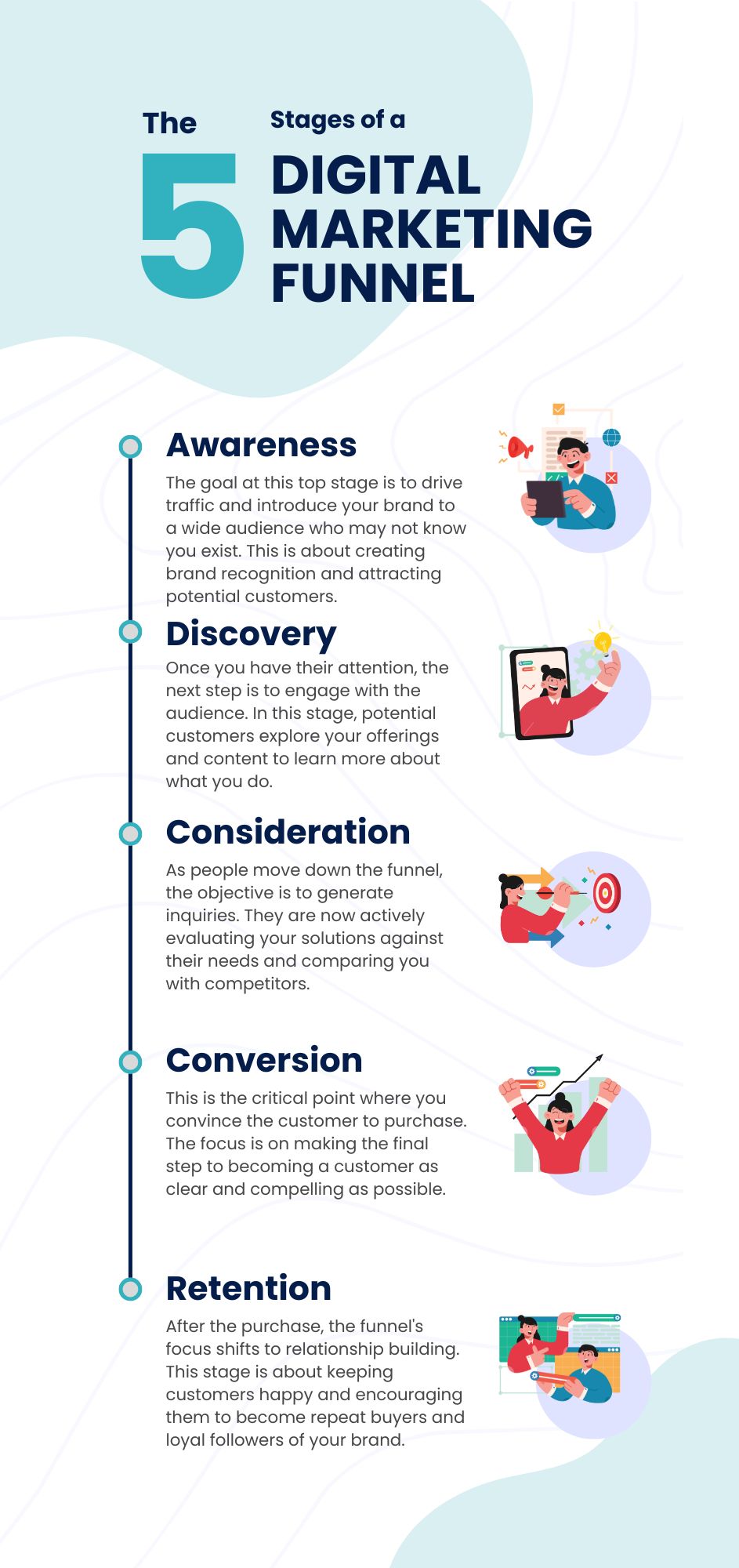
The five stages of the B2B digital marketing funnel are:
- Awareness – a potential customer becomes aware your business exists
- Interest – they start to engage with your content or website
- Evaluation / Consideration – they compare you with competitors and assess your credibility
- Conversion – they contact you, request a quote, or make a purchase
- Retention – they become a repeat customer and refer others
Why the B2B Marketing Funnel Matters
How much of the B2B buying journey happens before a buyer contacts a vendor?
According to Gartner research, approximately 80% of the B2B buying journey now takes place before a buyer ever makes contact with a vendor. Before they reach out, most buyers have already reviewed an average of 11 pieces of content and consulted multiple digital sources, according to Sopro’s 2025 B2B buyer research.
What this means in practice: by the time a potential customer contacts you, they’ve very often already decided whether they want to work with you. The 6sense 2025 Buyer Experience Report found that 81% of buyers already have a preferred vendor in mind at the point of first contact, and the vendor that gets onto a buyer’s shortlist on day one wins the deal roughly 80% of the time.
Your marketing funnel is how you get onto that shortlist before the buyer reaches out. If you’re not visible and credible during the research phase, you won’t be considered when they’re ready to buy.
Stage 1: Awareness – Getting Found
What is the goal of the awareness stage?
The goal is simple: make sure that when a potential customer is searching for what you offer, they find you. They might be searching on Google, browsing LinkedIn, asking a peer for a recommendation, or – increasingly – asking an AI tool.
What channels drive discovery for B2B businesses?
- Search engine optimisation (SEO) remains the most reliable long-term driver of B2B discovery. 90% of B2B buyers use online channels as their primary way to find new suppliers, and the majority of those journeys begin with a search engine query. A well-optimised website with content that addresses your buyers’ specific questions puts you in front of the right people at exactly the right moment – when they’re actively looking.
- Paid search (PPC) gives you immediate visibility for high-intent search terms. Where SEO takes time to build, PPC can generate qualified traffic from day one. The two work best in combination: PPC captures demand while SEO builds organic presence over time.
- LinkedIn is the most effective social platform for B2B discovery, both organically through thought leadership content and through paid targeting. For businesses with the budget to invest, LinkedIn’s ability to target by job title, company size, and sector is genuinely powerful.
- AI Search is an emerging but rapidly growing discovery channel that deserves serious attention. 94% of B2B buyers now use AI tools like ChatGPT and Perplexity during their buying process, and 72% encountered Google’s AI Overviews during their research. These tools surface businesses based on how well their website content is structured and how authoritatively they’ve written about relevant topics. Optimising for AI search – a practice known as Generative Engine Optimisation (GEO) – is no longer a future consideration. Buyers are already using these tools to build their shortlists. If you’re not sure how AI tools decide which businesses to recommend, our guide on how to optimise for AI search explains what actually makes the difference.
- What to measure at this stage: new website visitors from organic search, keyword rankings, ad impressions and clicks, LinkedIn reach and follower growth.
Stage 2: Interest – Keeping Them Engaged
What is the goal of the interest stage?
Once a potential customer has found you, the goal is to give them a reason to stay – and a reason to come back. This stage is about demonstrating that you understand their challenges and have genuinely useful things to say about them.
What content works best at the interest stage?
The most effective interest-stage content directly addresses the questions your potential customers are already asking. Blog posts, guides, and case studies that answer specific questions – “what’s the best digital marketing for a B2B service business?”, “how long does SEO actually take to work?”, “what should I expect to pay for PPC management?” – attract buyers who are in active research mode and give them a reason to engage with your brand before they’re ready to buy.
Video content performs particularly well at this stage. 76% of B2B marketers use video as a top content format, and for good reason: it builds personal connection with an audience that hasn’t met you yet and establishes credibility in a way that text alone cannot.
The key principle is genuine usefulness. Content that exists to rank for a keyword but tells the reader nothing they didn’t already know won’t hold anyone’s attention. B2B buyers are sophisticated – they can recognise AI-generated filler content immediately, and it actively harms your credibility rather than building it.
What to measure at this stage: time on page, scroll depth, pages per session, return visitor rate, content downloads.
Stage 3: Evaluation – Building Trust and Credibility
What is the goal of the evaluation stage?
At the evaluation stage, a potential customer is actively comparing you with your competitors. They’re looking for evidence that you can do what you claim, that other businesses like theirs have worked with you successfully, and that there are no red flags that should make them look elsewhere.
What builds credibility at the evaluation stage?
- Client testimonials and case studies are the most powerful trust signals available. Specific, attributed testimonials – with a client name, their role, and a concrete outcome – carry far more weight than generic praise. Case studies that follow a problem-solution-result structure give buyers a clear picture of what working with you actually looks like.
- Third-party reviews on platforms like Google Business Profile, Trustpilot, or Reviews.io provide independent validation that prospects trust more than anything you say about yourself. 54% of technology buyers consult user reviews during the buying journey, according to TrustRadius research.
- Transparent pricing is increasingly important. 74% of B2B buyers expect clear pricing information upfront, and businesses that hide their pricing behind a consultation form are filtering themselves out of consideration for a significant proportion of buyers. Publishing pricing – or at least giving a clear indication of what things cost – is a genuine competitive advantage in most B2B sectors.
- Thought leadership content – original perspectives on industry topics, commentary on developments affecting your clients, evidence of deep expertise – signals to buyers that you’re worth taking seriously. A business whose content sounds like every other agency is indistinguishable from every other agency.
What to measure at this stage: referral traffic from review platforms, backlink acquisition, branded search volume (people specifically searching your name), time spent on service and about pages.
Stage 4: Conversion – Turning Interest into Action
What is the goal of the conversion stage?
The conversion stage is where everything else is either validated or wasted. A potential customer who has found you, engaged with your content, evaluated your credibility, and decided you’re the right choice should have a frictionless path to making contact. If your contact process creates unnecessary barriers, you will lose deals that were already won.
What reduces friction at the conversion stage?
- Short, clear contact forms that ask only for what’s genuinely needed. Every additional field reduces completion rates – name, email, company name, and an optional notes field is typically sufficient to qualify an enquiry without deterring people from submitting it.
- Multiple contact options. Some people prefer to call. Some prefer email. Some prefer to fill in a form. Offering all three and making them easy to find removes the friction of having to adapt to a single channel.
- Retargeting. The vast majority of visitors who engage with your website don’t convert on their first visit. Retargeting campaigns – paid ads that follow previous visitors across the web and remind them of your business – bring back buyers who showed interest but weren’t ready to act. For B2B businesses with longer sales cycles, this is one of the highest-return advertising activities available.
- Clear next steps. Tell visitors exactly what happens when they get in touch. “We’ll respond within one working day, have a 30-minute call to understand your situation, and send you a proposal within a week” is far more reassuring than a generic “get in touch” button with no indication of what follows.
What to measure at this stage: form completions, phone calls (using call tracking), cost per lead, conversion rate from visitor to enquiry.
Stage 5: Retention – Keeping and Growing Clients
Why does retention matter in a B2B marketing funnel?
Acquiring a new client costs significantly more than retaining an existing one. For B2B service businesses, client retention and referrals are often the most cost-effective growth lever available – and they’re the ones most frequently neglected once the focus shifts to new business generation.
Clients who stay with you become advocates. They provide testimonials, make referrals, and give you case study material that makes every other stage of the funnel more effective. The average Greyturtle client relationship runs to over four years – not because clients are locked into contracts (they aren’t), but because the value delivered makes staying the obvious choice.
Email marketing is the primary tool for staying in front of existing clients and warm prospects. A regular, genuinely useful newsletter – not a promotional mailout – keeps your business visible and reinforces your expertise during the gaps between projects. It’s also one of the most cost-effective marketing channels available to SMEs at any budget level.
What to measure at this stage: client retention rate, revenue from existing clients, referral rate, email open and click rates.
The Biggest Mistake B2B SMEs Make with Their Funnel
What is the most common digital marketing funnel mistake?
Not measuring anything – and defaulting to the activities that feel most visible or most enjoyable rather than those that actually generate results.
We see this constantly. A business owner who enjoys social media invests disproportionate time and budget there, while their Google Business Profile sits unclaimed, their SEO is nonexistent, and they have no idea how many website visitors are reaching their contact page and leaving without enquiring. Another business spends heavily on LinkedIn ads because a competitor appears to be doing so, without ever establishing whether those ads are actually generating leads.
The funnel framework is valuable precisely because it forces the question: “Is this activity actually moving people towards a purchase, and how do I know?” If you can’t answer that question for a given marketing activity, you’re spending money or time on faith rather than evidence.
What should B2B SMEs measure first?
Start with the basics before adding complexity. Google Analytics 4 shows you where your visitors come from, which pages they visit, and where they drop off. Google Search Console shows you which search queries are bringing people to your site and how your rankings are changing over time. Your contact form completion data tells you whether your conversion rate is acceptable or whether there’s a problem worth investigating.
These three free tools, used consistently, will tell you more about your marketing performance than most expensive analytics platforms – and they’ll show you quickly which funnel stages are working and which have a leak.
Useful Tools by Funnel Stage
| Funnel Stage | Recommended Tools |
|---|---|
| Discovery | Google Search Console, SEMrush, Ahrefs, LinkedIn Campaign Manager |
| Interest | Google Analytics 4, Microsoft Clarity (free heatmapping), Hotjar |
| Evaluation | Google Business Profile, Trustpilot, BrightLocal |
| Conversion | Google Analytics 4 (goal tracking), WhatConverts (call tracking), Google Ads (retargeting) |
| Retention | Mailchimp or Klaviyo, CRM of your choice |
A Simple Funnel Audit: Where Are You Leaking Leads?
Before investing more in any marketing activity, it’s worth understanding where your current funnel is weakest. Here’s a straightforward diagnostic:
- Discovery gap: Are you ranking on page one of Google for your main service keywords? If not, potential customers are finding competitors instead of you.
- Interest gap: When visitors arrive on your website, do they stay? A high bounce rate on key pages suggests your content isn’t immediately relevant or your site loads too slowly.
- Evaluation gap: Do you have client testimonials on your site? Are they specific and attributed? Do you have a review presence on Google or Trustpilot? If not, buyers researching you will find a credibility vacuum.
- Conversion gap: What percentage of your website visitors actually contact you? For most B2B service websites, a conversion rate below 1% suggests a problem with the contact process or the clarity of your calls to action.
- Retention gap: What percentage of your clients return for additional work or refer others? If retention is low, the problem is often a lack of ongoing communication rather than poor service delivery.
Identifying your weakest stage is usually the most valuable thing you can do before deciding where to invest next. Spending more on top-of-funnel activity when your conversion process is broken simply pushes more people to a leaky bucket.
Build Your B2B Marketing Funnel Around Your Sector
The right balance of activities across the funnel varies significantly by sector and by budget. A niche B2B service business with a small marketing budget should invest very differently from a B2B ecommerce business with a substantial paid media budget. If you haven’t already, it’s worth reading our guide on what digital marketing is actually right for your business – it covers how to think about channel selection based on your specific situation before committing budget to any particular approach.
About the Author:

Catherine Hazeldine
Know your B2B Marketing Funnel
Start Measuring, Stop Guessing
The businesses that grow consistently through digital marketing aren’t necessarily the ones doing the most activities. They’re the ones that know which activities are working, invest accordingly, and cut what isn’t delivering.
If you’re not sure which part of your funnel is the problem – or whether you have a funnel at all – we’re happy to take a look and give you a straight answer.
Tell us about your B2B business and we’ll show you exactly where your marketing funnel is losing leads.